Agentic AI Course
Design, build, and ship autonomous AI agents across no-code platforms, Python, and multi-agent systems
200Hours
4Months

Course fees are inclusive of taxes · 0% interest EMI also available
I had the best experience with analytixlabs. The training that I got here was really good and that helped me in getting a job and the profile which I required.

Nirjr Madaan
EXL Services
Includes
- Industry-Recognized Certification
- Flexible Doubt-Clearing Sessions
- Dedicated Placement Support
- Lifetime LMS Access
Overview

96 Hours Live Training+ Self Study & Practice

Capstone Projects& Assignments

Placement Supportand Career Guidance
Course Overview
Agentic AI now sits at the core of most business functions. An agent decides the next step, calls the right tool, and adjusts when something fails. It knows when to act, and how.
This Agentic AI course addresses the widening gap between available jobs and skilled professionals. The global job market is seeing steady growth in new agentic AI roles, but the number of skilled talent available has yet to match the pace. Learn Agentic AI skills that matter, because opportunities will only grow manifold.
Most organizations have people who can write prompts but very few have people who can put an agent into production and keep it stable when it fails. This gap shows up in hiring too. In our latest talent report, we noted that more agentic AI roles are open than qualified candidates.
Two things follow from that shortage.
- Experienced practitioners command a higher salary band because supply is thin.
- Professionals with 2 to 3 years in adjacent roles can enter on demonstrated skill, not years served. That rarely happens in an established field.
Close that gap by building an agent, deploying it, and keeping it stable in production. This Agentic AI online course is the right starting point.
This is why most hiring managers frame interview questions around handling an autonomous agent in production. They ask what you did when a tool call returned nothing and the agent kept looping or how you capped the token spend on a workflow that ran unsupervised overnight.
This Agentic AI certification course will teach you where, why, and how to place a human checkpoint with your autonomous agents. You see what happens when you leave that checkpoint out. You then debug the same class of failure yourself, across both modules.
What You Will Learn?
In this course, you learn how AI agents work across industries and domains. You build and deploy them yourself. You then create multi-agent systems, streamline the workflows around them, and tie agent development to business goals.
This course builds six core skills. You apply each one in a working build before the programme ends.
- Agent architecture: Understand memory, planning, tool use, and autonomy as separate components you can debug individually.
- Framework fluency: Work hands-on in LangChain, LangGraph, CrewAI, and AutoGen. You learn when each one fits and when it does not.
- No-code and low-code automation: Build production workflows in Zapier and Make, then extend them in n8n. Python comes after that.
- Retrieval and grounding: Design RAG pipelines with vector databases so your agents answer from your data, not from guesswork.
- Deployment: Ship agents through FastAPI, Streamlit, and Gradio, then monitor them with LangSmith.
- Responsible AI: Apply guardrails, human-in-the-loop checks, and output verification to systems that act on their own.
What Are AI Agents? Types and Examples Covered in This Course
An AI agent perceives its environment, decides what to do next, and acts. The decision loop is what separates an agent from a chatbot that only responds.
Agent design has a long history, and the categories still shape how you build today.
Types of AI Agents
- Simple reflex agents: Respond to the current input and nothing else. A thermostat is the textbook case.
- Model-based agents: Hold an internal picture of the world. They can act sensibly when they cannot see everything at once.
- Goal-based agents: Plan a sequence of steps toward an outcome. Route planning works this way.
- Utility-based agents: Weigh competing options and pick the one with the best expected payoff.
- Learning agents: Improve from feedback rather than staying fixed after deployment.
- Knowledge-based agents in AI: Reason over a stored knowledge base before acting. They separate what they know from how they reason about it. This matters in practice. A RAG pipeline is a modern knowledge-based agent. The vector database stands in for the classical knowledge base.
AI Agents Examples
- Research agent: A research agent takes a question, searches multiple sources, and returns a cited summary. It decides how many sources to check before it stops.
- Support triage agent: A support triage agent reads an incoming ticket, classifies it, and routes it to the right queue. It pulls the order history first, then decides whether to escalate or resolve automatically.
- Ops reconciliation agent: An ops reconciliation agent compares a payment file against invoice records each morning. It flags mismatches, drafts the follow-up email, and holds anything above a set value for human sign-off.
Course Curriculum
This Agentic AI course offers a solid understanding of where and how Agentic AI fits in the AI world. With hands-on projects and assignments, you will transition smoothly into the core technologies. At the same time, you build the surrounding skills including critical thinking, AI ethics, communication, and AI project management.
The program also includes additional modules that extend your learning.
Download the brochure for the complete module-wise curriculum.
- AI vs. Automation vs. Analytics
- AI, Machine Learning (ML), Deep Learning (DL) – differences & connections
- Narrow AI vs. General AI vs. Super AI
- Core AI applications (NLP, CV, Robotics, Predictive Analytics)
- Traditional AI vs. Gen AI
- Every day, GenAI applications
- How does GenAI work?
- Key models (GPT, Claude, Gemini, LLaMA)
- Text generation & completion techniques
- Prompt Engineering basics: role, task, context
- Core Prompting Tasks (Text generation & completion, Summarization (short & detailed), Rewriting in different tones/styles)
- Prompt Structures (instructional, role-based)
- Prompting Techniques (Zero-shot prompting, Few-shot prompting, Chain of Thought (CoT) prompting
- Role Prompting, Multi-turn interactions (context retention), etc..
- Limitations of prompting
- Evaluating GenAI output quality
- Introduction to transformers
- LLMs vs. SLMs
- Popular LLMs (GPT, Claude, Gemini, LLaMA) – Overview – Strengths & Limitations
- Introduction to Embeddings
- No-code AI overview
- Intro to workflow automation tools
- Introduction to Zapier basics (triggers & actions), n8n workflow design, Make.com integrations
- AI-powered productivity with Notion AI for task automation & summarization, Airtable for data storage & automation, Glide for mobile app prototyping, etc.
- Design & Storytelling Tools
- Integrating AI into everyday workflows – Linking AI workflows with business processes
- Prototyping with no-code/low-code tools
- Agentic AI vs. AI Agents
- Key components of Agentic AI: memory, planning, tool use, autonomy
- AI Orchestration with no-code tools
- Agent frameworks (LangChain, AutoGen, CrewAI – overview)
- Responsible AI principles: Fairness, Accountability, Transparency, Explainability
- Global AI Ethics Frameworks
- Safe & Responsible usage
- Responsible AI: Guardrails
Why Learn No-code/Low-Code Automation Tools?
You do not need Python to build your first working agent. This course opens with no-code and low-code automation tools, so you understand workflow logic before you write code.
A no-code automation platform lets you connect apps and trigger actions through a visual builder. A low-code automation platform adds scripting where the visual builder runs out of room. Both matter, because most business automation lands somewhere between them.
You work hands-on with no-code automation tools including Zapier, Make, Notion AI, Airtable, and Glide. You then move to low-code automation tools such as n8n, where you add custom functions and API calls to a visual workflow.
Low-code automation also has a ceiling. You will find it during Module 1, when a workflow needs branching logic or memory that the builder cannot express. That is the moment Python earns its place, and it is where Module 2 begins.
Key Skills
- Understand the foundations of AI and Generative AI
- Master prompt engineering and prompting frameworks for real-world scenarios
- Automate workflows with no-code/low-code AI tools
- Design and deploy AI Agents for business and personal productivity
- Understand core AI & GenAI fundamentals
- Build LLM-powered apps with LangChain & Vector DBs
- Design & deploy AI agents using Python frameworks
- Work with practical enterprise use cases in automation
- Apply AI responsibly with awareness of ethical, bias, and governance considerations
Who Should Do?
Career changers moving into AI
You build a job-ready skill set across generative and agentic AI, and you leave with capstone projects you can defend in an interview.
Data practitioners
You move from theory to production through Python projects covering LangChain, LangGraph, CrewAI, RAG pipelines, and deployment.
Functional managers and team leads
You learn enough architecture to scope agent projects, judge vendor claims, and set realistic timelines.
Researchers and technical enthusiasts
You go deep on multi-agent orchestration, MCP, multi-modal LLMs, and transformer internals.
Job Roles
- GenAI Associate / AI Analyst (Junior)
- Prompt Engineer (Entry-level)
- No-Code Automation Specialist
- AI Operations Executive
- Digital Transformation Associate
- AI Product Manager (GenAI focus)
- AI Research Engineer
- AI Solutions Architect (GenAI)
- AI Platform Engineer
- Conversational AI Engineer
- RAG Architect
- Agentic AI Engineer
- GenAI Developer
- LLM Application Developer
- NoCode AI Builder
- AI Automation Manager
- AI Workflow Consultant
- AI Engineer (LLM / GenAI)
Agentic AI Certification Details
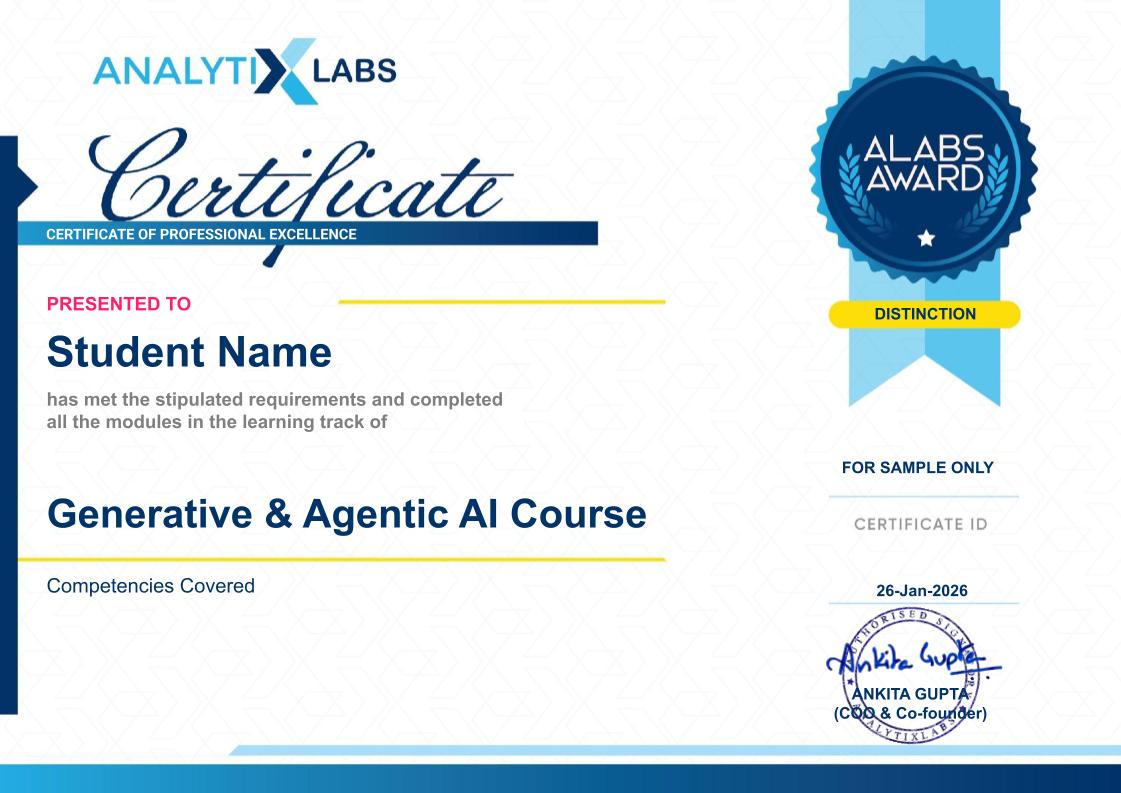
On successful completion of all stipulated requirements, including a final evaluation, you will be awarded AnalytixLabs Certification. AnalytixLabs certifications are highly regarded in the industry due to our extensive domain expertise. As India’s leading Data Science and AI institute, we maintain rigorous integrity in our certification process.
To secure certification, you must meet the specified requirements within your course timeline. This includes:
- Completing all required case studies
- Passing multiple-choice assessments (MCQs)
- Fulfilling additional course-specific criteria
You will have two attempts to pass each assessment.
Certification must be secured within one year of your course registration. We provide essential hands-on experience throughout your learning journey to prepare you for industry challenges.
Agentic AI Course Fees & Learning Mode
Agentic AI course fees cover live instructor-led sessions, both capstone builds, the assessed case studies, and certification. You can split the fee into instalments or choose an interest-free EMI plan. Your learning advisor confirms the current fee and any batch offer before you pay.

Interactive Live Online
₹ 42,000 + taxes
Blend classroom dynamics with engaging, real-time interactive Online sessions tailored to busy schedules. This innovative approach combines traditional and digital learning, ensuring effective knowledge retention. Experience deeper understanding through flexible, responsive instruction designed for modern learners.
- Fees payable in installments
- 0% Interest EMI – Pay in Easy Installments (though education financing partners)
- Cost-effective courses with high ROI, making it worth every penny you invest.

Blended eLearning
₹ 36,000 + taxes
Fuse the rich atmosphere of classroom instruction with the flexibility and accessibility of eLearning modules, meticulously integrated to accommodate learning preferences. This unique blend ensures an optimal learning experience, empowering participants to delve into subjects deeply.
- Fees payable in installments
- 0% Interest EMI – Pay in Easy Installments (though education financing partners)
- Cost-effective courses with high ROI, making it worth every penny you invest.
3-Step Admission Process
- You start by registering your interest through the website, email, chat, or phone. A learning advisor contacts you within 24 to 72 hours.
- Your advisor reviews your background and confirms whether this course fits your goals. If a different programme suits you better, they will say so.
- You then choose your batch and learning mode, and pay the admission fee to confirm your seat.
Career Support and Guidance
AnalytixLabs is committed to helping you launch a successful career in AI, Data Science, and Analytics. With comprehensive Placement Assistance integrated into our Advanced Certification programs, our dedicated team of industry professionals offers personalized support based on your educational background and work experience. The placement process is designed to equip you with both opportunity and readiness-helping you transition seamlessly into the data-driven workforce.

Placement Guidance
Our training focuses on building job-ready skills that prepare students for successful placements. Students receive continuous guidance from our experienced faculty on job applications and interview preparation. We also conduct mock interviews, when required, and provide one-to-one feedback and personalized guidance. We also share placement opportunities, career guidance, and industry insights to keep students informed about current hiring trends.

Diverse Job Opportunities
Access to job opportunities through direct collaborations with organizations, reputed recruiters, and the extensive AnalytixLabs Alumni network. Many students receive multiple interview calls and see a significant boost in career prospects. Success, however, depends on a combination of the candidate's dedication and the institute's support. Active participation and timely course completion are essential for maximizing placement outcomes.

Continued Career Support
We offer ongoing placement support to ensure you stay on track until you achieve your career goals. Our dedicated team continues to assist with job opportunities, interview preparation, and personalized guidance as long as you need it. Many of our students benefit from multiple interview calls and long-term career growth, thanks to the strong foundation and in-demand skills built during the course.
Candidates Trained by Us Are Working in Leading Companies…
What Students Say About Us?
True Stories, Transformative Career Experience
Mohit Yadav
(Associate Manager, HCL)
I opted for Data Science with R & Python with AnalytixLabs. It was one of the best decisions I ever have. The sessions were very informative and I was able to interact with the trainers very efficiently for clearing my doubts. Mr. Chandra is one of the best trainers in this domain and I have a very good time learning from you. Recommend this course 10/10.
Sign up for a Free Demo Class
Benefits of Demo Account
 GET ACCESS TO TRIAL SESSIONS TO CHOOSE THE MOST SUITABLE COURSE.
- SAVE UP TO 40% on specialization learning tracks.
- JOB ORIENTED COURSES crafter and delivered by industry experts.
- INDUSTRY RELEVANT programs with latest curriculum.
Want to see how it works?
Sign up for Demo
Related Articles
Frequently Asked Questions
An AI agent perceives its environment, decides what to do next, and acts on that decision. Unlike a chatbot, it chooses its own next step. Agent types range from simple reflex agents to knowledge-based agents in AI, which reason over a stored knowledge base before acting.
Excited?
Talk to Expert Counselor
Gain personalized insights into your profile, evaluate eligibility for our Job Guarantee & subsidy programs, and strategize your next breakthrough career move!
Request a Call back
Fill in your details and our senior counselor will reach out within 2 hours.